Quick answer
In most Ohio homes with natural gas, a gas furnace or a dual-fuel system (heat pump plus furnace) is the practical choice, because the furnace carries the coldest nights while the heat pump heats efficiently in milder weather. Homes on propane, oil or all-electric heat often save by moving to a cold-climate heat pump.
Heat pumps have come a long way, but Ohio winters still test them. Here is how a heat pump, a gas furnace and a dual-fuel setup compare in a Miami Valley home.
For most Southwest Ohio homes with natural gas available, the answer is not either-or. A gas furnace handles the coldest nights with ease, a heat pump heats very efficiently through the mild shoulder seasons, and a dual-fuel system uses each where it is strongest. Homes without gas, or owners who want to go all-electric, can do well with a properly sized cold-climate heat pump.
The right choice depends on your utility rates, your ductwork, how well the house holds heat and how you feel about gas appliances. Here is how our technicians explain the tradeoffs.
How Each System Makes Heat
A gas furnace burns fuel and moves the heat across a heat exchanger into your ductwork. Supply air typically comes out of the registers noticeably hot, and output does not drop when the temperature outside falls.
A heat pump burns nothing. It uses refrigerant and a compressor to pull heat from outdoor air and move it inside, the same way an air conditioner works in reverse. Because it moves heat rather than creating it, a heat pump can deliver more heat energy than the electricity it consumes. The catch is that as outdoor temperatures drop, there is less heat to harvest, and both capacity and efficiency fall.
The Ohio Balance Point
Every heat pump has a balance point: the outdoor temperature where its output no longer keeps up with the home's heat loss. Below it, backup heat has to make up the difference. On a conventional heat pump in a typical Miami Valley house, that point often falls somewhere around freezing, and Dayton-area winters spend plenty of nights below it.
In an all-electric system, the backup is electric resistance heat strips in the air handler. They work, but they are the most expensive way to heat with electricity. That is why a standard heat pump alone can feel underwhelming during a January cold snap.
Cold-climate heat pumps change the math
Cold-climate models use variable-speed inverter compressors and enhanced refrigerant circuits to keep producing useful heat well below freezing. With one sized from a proper load calculation and a tight house, many Ohio homeowners rarely touch their heat strips. They cost more up front, and installation details like refrigerant charge and airflow matter even more than usual.
Why heat pump air feels different
Homeowners switching from gas often say the heat pump air feels lukewarm at the register. That is real. A furnace commonly delivers supply air well above body temperature, while a heat pump in cold weather delivers a gentler stream that runs longer to hold the same thermostat setting. The house can be just as warm, but people who like standing over a floor register in the morning notice the change. A variable-speed system that runs low and steady helps, and so do registers that are not blowing straight at a sofa.
Defrost cycles and runtime
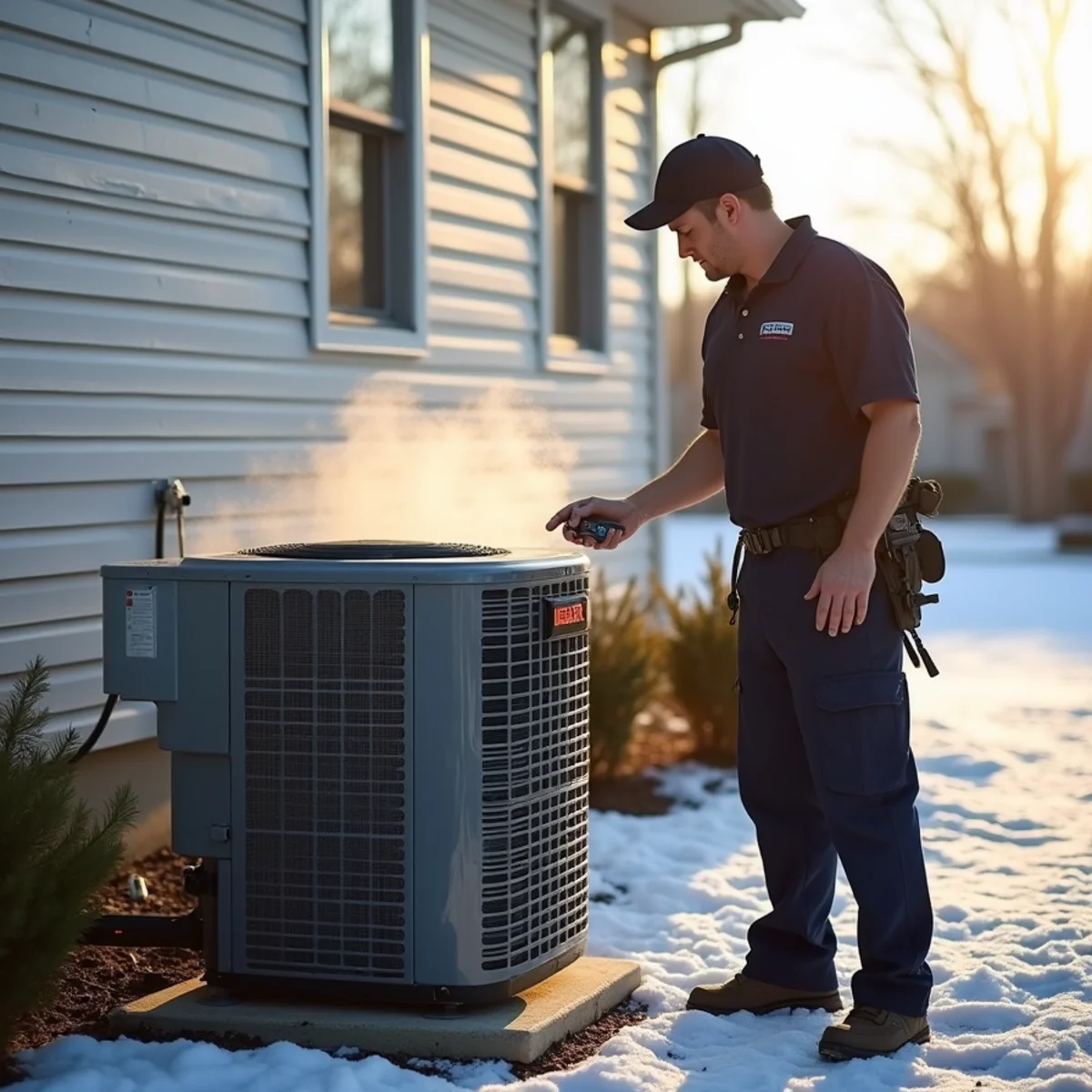
In damp weather near freezing, frost builds on the outdoor coil and the heat pump briefly reverses to melt it. You may see a cloud of steam from the unit and hear a whoosh as the reversing valve shifts. That is normal. What is not normal is a coil that stays encased in ice for hours, which usually points to a failed defrost sensor or board, low charge or a blocked drain path under the unit. Because a heat pump heats and cools, it also logs far more compressor hours per year than a furnace, which is part of why its service life tends to run shorter.
Dual Fuel: The Best of Both
A dual-fuel system pairs a heat pump with a gas furnace. The heat pump carries the load in fall and spring and through milder winter days; when temperatures drop below a switchover point we program into the thermostat, the furnace takes over. You also get central air from the same heat pump in summer.
- Efficient electric heating in shoulder seasons, when heat pumps shine
- Strong, hot gas heat on the coldest nights with no resistance strips
- Redundancy: if one heat source has a problem, the other can keep the house warm
- Switchover can be set by outdoor temperature or tuned to your gas and electric rates
Start With the Fuel You Have
The single biggest factor in this decision is what is already piped or wired to the house. A rough guide we use on estimates:
- Natural gas at the street and in the basement: a high-efficiency furnace or dual fuel usually makes the most sense.
- Propane from a tank: propane typically costs more per unit of heat, so a heat pump carrying most of the season with the propane furnace as backup can cut tank refills considerably.
- All-electric with resistance heat or an old electric furnace: a heat pump, ideally a cold-climate model, is almost always a big step up.
- Fuel oil in an older rural home: a heat pump or dual-fuel conversion is worth pricing before replacing the oil burner.
Operating Cost: Gas vs. Electric Rates
Which system is cheaper to run depends on the ratio between what you pay for natural gas and what you pay for electricity, and those rates move. Historically, natural gas has been relatively inexpensive in Ohio, which is a big reason furnaces dominate here. When electric rates are favorable, a heat pump gains ground; when gas is cheap, the furnace does. Dual fuel lets you hedge.
Reading the Ratings
| Rating | Applies to | What it tells you |
|---|---|---|
| AFUE | Gas furnaces | Share of fuel converted to usable heat over a season |
| HSPF2 | Heat pumps (heating) | Seasonal heating output per unit of electricity, under updated test conditions |
| SEER2 | Heat pumps and ACs (cooling) | Seasonal cooling efficiency under updated test conditions |
Higher is better for all three, but ratings only hold up if the installation is right. Undersized ducts, low airflow or an incorrect refrigerant charge can cost a heat pump a meaningful chunk of its rated efficiency.
What We Recommend in Local Homes
In the newer subdivisions of Springboro and Clayton, many homes already have a gas furnace and a central AC due for replacement at the same time. Swapping the AC for a heat pump and keeping or upgrading the furnace is often a natural path to dual fuel. For homes without gas service, a cold-climate heat pump with modest backup is usually the direction we point.
If you already have a heat pump that is struggling, the fix may be simpler than a replacement. Our heat pump repair technicians regularly find failed defrost boards, reversing valves or low refrigerant behind poor winter performance. And if a gas system is the better fit, our furnace and heating team can size and install it.
Talk Through Your Options
No blog post can replace a look at your actual house. Call us to set up a visit, and we will review your ductwork, insulation and utility setup, then lay out furnace, heat pump and dual-fuel options side by side.
Choosing Between a Heat Pump and a Furnace for Your Own Ohio House
National comparisons tend to average away the two numbers that decide this for you: your local utility rates and how cold your house actually gets. The sections below give you a way to run the comparison with your own bills, a side-by-side of the four setups we install, and the practical details that matter in the Miami Valley.
Compare operating cost with your own bills
Both fuels can be converted to the same yardstick: the cost to deliver one million BTU of heat into the house. The conversions are fixed physics, not estimates. One therm of natural gas contains 100,000 BTU, and one kilowatt-hour of electricity equals about 3,412 BTU, so a million BTU is 10 therms or roughly 293 kWh.
- Find your all-in gas cost per therm on the gas bill, including delivery charges, not just the supply rate.
- Divide 10 by your furnace's AFUE as a decimal (0.80, 0.96) and multiply by the per-therm cost. That is your furnace's cost per million BTU delivered.
- Find your all-in electric cost per kWh, again including delivery.
- Multiply that by 293, then divide by the heat pump's coefficient of performance (COP). A COP of 3 means three units of heat for every unit of electricity; cold weather pulls that number down toward 2 or lower.
- Compare the two results. Where the heat pump number is lower, it is the cheaper heat source at that outdoor temperature. That crossover is the economic switchover point for a dual-fuel thermostat.
Ask us for the COP your specific heat pump model is rated to deliver at 47 and 17 degrees; manufacturers publish both points. Running the math at each shows where your home crosses over.
Four setups side by side
| Setup | Coldest nights | Spring and fall | Summer cooling | Usually fits |
|---|---|---|---|---|
| Gas furnace + central AC | Strong, hot supply air | Furnace short-cycles on mild days | Separate AC | Homes with gas and a healthy AC |
| Standard heat pump + electric strips | Leans on heat strips below the balance point | Very efficient | Included | Mild-use homes, all-electric houses with good insulation |
| Cold-climate heat pump | Keeps producing useful heat well below freezing | Very efficient | Included | All-electric, propane or oil homes ready to drop combustion |
| Dual fuel (heat pump + gas furnace) | Gas furnace takes over | Heat pump carries the load | Included | Gas homes replacing an aging AC |
What it takes to add a heat pump to an existing furnace
- A furnace young enough to outlast the new heat pump, ideally with a variable-speed or multi-speed blower.
- A new indoor coil matched to the heat pump, since most old AC coils are not rated for heat pump operation.
- A thermostat or furnace control that supports dual fuel and an outdoor sensor for the switchover.
- An electrical circuit sized for the new outdoor unit, confirmed against the panel.
- A line set checked or replaced for the new refrigerant, plus a raised pad so the unit sits above drifting snow.
Miami Valley conditions that shape the choice
Winters here swing back and forth across freezing, which is the exact range where heat pumps defrost most often. Wet snow followed by a hard freeze can lock ice around an outdoor unit sitting on a ground-level pad, so we set heat pumps on risers and keep the defrost meltwater draining away from walkways. Spring cottonwood season can mat the outdoor coil, and a heat pump that cools all summer with a blanketed coil pays for it in winter efficiency. If yours is already struggling on cold mornings, our heat pump repair visit checks defrost controls and charge first. If you are replacing everything at once, our HVAC system replacement quotes lay out furnace, heat pump and dual-fuel options side by side, and our guide to a furnace that quits in an Ohio cold snap covers what to do if the gas side stops on the worst night.
From our technicians
What we find when a heat pump disappoints in winter
When a homeowner tells us their heat pump cannot keep up, the equipment is usually not the whole story. We check the refrigerant charge against the manufacturer's chart, measure airflow across the indoor coil, and look at how the thermostat is programmed. A common find is a thermostat set up for a plain furnace, or one with large nightly setbacks, so the system calls for emergency heat strips every morning to recover. Another is an outdoor unit tucked under a deck or against a wall where it recirculates its own cold air and frosts up faster.
On dual-fuel installs, the switchover setting matters more than people think. Set too high, the furnace does work the heat pump could handle cheaply. Set too low, the heat pump runs long cycles blowing tepid air on a 20-degree night. We usually start near the heat pump's balance point for that house and adjust after the first cold stretch. Our honest tradeoff: in a leaky 1950s house with small ducts, a heat pump alone rarely feels as comfortable as gas until air sealing and duct work are addressed first.
Want a technician to take a look?
Comfort Air Solutions serves Miamisburg, Dayton and the Miami Valley — 24/7 emergency service.
- 4.8★ · 32 Google reviews
- 25+ years’ experience
- Written options before work
- Factory-Authorized Bryant® Dealer