Quick answer
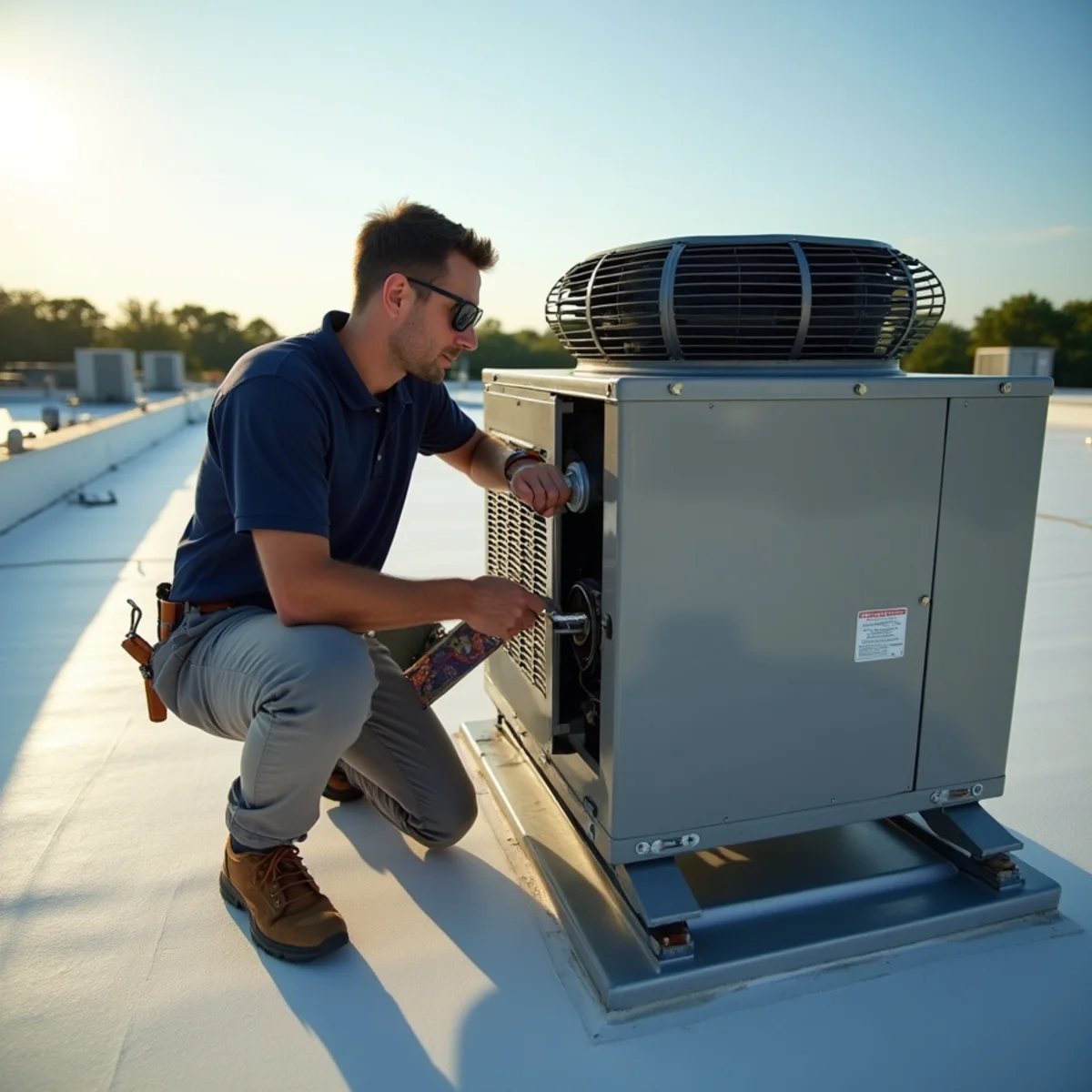
Commercial HVAC maintenance prevents downtime by putting every unit on a written schedule, usually spring and fall start-ups with quarterly checks for restaurants and busy offices. Technicians record readings, replace belts, capacitors and filters before they fail, test gas heat safety, audit thermostat schedules, and flag aging equipment so owners can budget instead of scrambling.
How offices, retail stores and restaurants along the I-75 corridor can prevent HVAC downtime with a real preventive maintenance plan, clear records and after-hours service.
Short answer: the way to prevent HVAC downtime in a commercial building is a written preventive maintenance plan with scheduled visits, recorded readings for every unit, planned replacement of wear parts like belts and capacitors, and a contractor who answers the phone after hours. Most breakdowns in offices, retail and restaurants give warning signs weeks ahead. A PM program is how you actually see them.
What HVAC Downtime Really Costs
Along the I-75 corridor, from Moraine and Miamisburg down through Springboro to Springdale, Sharonville and Blue Ash, commercial buildings run on tight margins and tighter schedules. When the system fails, the problem goes far beyond a warm room.
- Offices: staff productivity drops, meetings move, and tenants start asking about their lease terms.
- Retail: customers leave a hot or cold store fast, and some inventory does not tolerate heat.
- Restaurants: kitchen heat loads plus a dead unit can make the line unworkable, and makeup air problems affect hood performance.
- Medical and dental: comfort and air quality are part of the patient experience, and some equipment is temperature sensitive.
Building a Preventive Maintenance Plan That Works
Start with an inventory
Every unit gets a tag and a record: make, model, serial, age, tonnage, filter sizes, belt sizes and what zone it serves. You cannot manage what you have not listed, and on a multi-tenant building nobody usually has the full picture.
Set the visit schedule
- Spring start-up: condenser coil cleaning, refrigerant readings, economizer test, belts, electrical checks, condensate drains.
- Summer check: filters, drains, coil condition, amp draws on compressors during peak load.
- Fall start-up: heating section inspection, combustion check on gas-fired units, ignition components, heat exchanger inspection.
- Winter check: filters, economizer minimum position, snow and ice around units, freeze protection.
Replace wear parts on purpose
Belts, capacitors, contactors and filters are predictable. Replacing them on schedule, instead of when they fail, turns an emergency call on a Friday afternoon into a routine line item on a Tuesday morning.
Audit the thermostats and schedules
Some of the cheapest downtime fixes are in the controls, not the equipment. Programmable and networked thermostats drift out of sync with how a business actually runs, especially after a tenant change or a daylight saving shift.
- Occupied and unoccupied schedules: matched to real business hours, including holidays, so units are not cooling an empty store at 2 a.m. or starting cold at opening.
- Setback temperatures: set close enough that the equipment can recover before staff arrive, without running flat out for the first two hours of the day.
- Sensor placement: thermostats on sunny exterior walls, beside a coffee maker or above a server closet give false readings and cause zone complaints.
- Fan mode: confirmed as constant during occupied hours where ventilation requires it, and auto after hours.
- Locking covers: added where employees keep changing setpoints and short-cycling the rooftop unit serving that space.
Maintenance Priorities by Business Type
| Business type | Common trouble spot | Maintenance priority |
|---|---|---|
| Office | Zoning complaints, VAV boxes, stuck dampers | Airflow balance and control checks |
| Retail | Door traffic, high sensible loads | Coil cleaning, belt and filter schedule |
| Restaurant | Grease-laden air, makeup air balance | Frequent filters, coil and drain cleaning |
| Medical/dental | Humidity and filtration | Higher-MERV filters, drain and coil care |
| Light industrial/flex | Dust and long run hours | Filter frequency, belts, bearings |
Early Warning Signs Worth a Call
- Squealing or slapping from a rooftop unit when the fan starts.
- Water stains on ceiling tiles near a unit or under the roof curb.
- One zone always running warm while others are fine.
- Short cycling or breakers tripping on hot afternoons.
- A burning, electrical or gas smell from supply registers. For any gas smell, clear the building and call 911 or your gas utility first.
Questions to Ask Any Commercial HVAC Contractor
- Will you give me a written report after every visit, with readings for each unit?
- Who answers the phone at 9 p.m. on a Saturday in January?
- Do your technicians hold EPA 608 certification, and do you keep refrigerant records for my equipment?
- Can you service every brand on my roof, or only the one you sell?
- Will you flag units that are nearing replacement so I can budget a year ahead?
Clear answers to those five questions tell you more about a maintenance partner than any brochure.
After-Hours Service Matters
Plenty of problems are best fixed when the building is empty. Our team handles scheduled maintenance at times that work for your business, and when a system goes down at night or on a weekend, our emergency HVAC repair line is answered around the clock. Someone picks up, and the next step is a technician on the way.
Beyond rooftop equipment, our light commercial HVAC service covers VAV zoning, ducted splits and small chiller plants, regardless of manufacturer. Our Miamisburg shop is a short hop from I-75, and we cover business corridors in Springdale and Blue Ash along with the Dayton side of the corridor.
Next Step
If your building has no written maintenance plan, or the last contractor stopped showing up, call our office to set up a site walk and a maintenance schedule built around your units and your hours.
Choosing and Running a Commercial HVAC Maintenance Program
Knowing that maintenance prevents downtime is the easy part. The harder questions are what kind of agreement to sign, how to tell whether the contractor is actually doing the work, and how to handle the spaces in a building that do not fit a standard rooftop schedule. This guide covers those decisions for owners and managers who do not have a facilities engineer on staff.
The four common agreement structures
The U.S. Department of Energy’s Federal Energy Management Program, in its Operations and Maintenance Best Practices guide, describes four broad types of maintenance contracts. The names vary between contractors, but nearly every agreement you will be offered fits one of these shapes.
| Agreement type | What it covers | Tradeoff for the owner |
|---|---|---|
| Full coverage | Scheduled maintenance, labor and parts for repairs, emergency calls | Most predictable budget; highest fixed commitment |
| Full labor | Maintenance and repair labor; owner pays for parts | Predictable labor, variable parts spending |
| Preventive maintenance only | A defined task list at set intervals; repairs quoted separately | Lower fixed commitment; repair spending varies year to year |
| Inspection only | Periodic look-overs with a report | Lowest commitment; little actual upkeep gets done |
For most small offices and retail buildings in the Miami Valley, a preventive-maintenance agreement with written repair quotes is the practical middle ground. What matters more than the label is what the scope actually says.
Scope-of-work language worth insisting on
- A task list per equipment type, not a single line reading “inspect HVAC system.” Rooftop units, split systems, makeup air units and exhaust fans each need their own list.
- Measured readings recorded at each visit: amp draws, refrigerant pressures with superheat and subcooling, supply and return temperatures, and combustion results on gas heat.
- Filter sizes, counts and change intervals written into the agreement for every unit.
- A repair approval process, stating the point at which a technician must call before doing extra work.
- How after-hours calls are handled and who answers them.
- Clear exclusions, so nobody is surprised when a cracked heat exchanger or a failed compressor falls outside the agreement.
Checking that the work is getting done
- Compare the visit report against the unit inventory; every tagged unit should appear every visit.
- Look for readings that change over time. Identical numbers visit after visit usually mean they were copied, not measured.
- Walk the roof occasionally, or ask for photos of coil faces and filter racks before and after service.
- Track service calls between visits. A rising count on one unit is a replacement-planning signal, not bad luck.
- Review the recommendations list each fall and decide which items get funded before winter.
Spaces that need their own plan
Some rooms do not follow the building schedule. Server and network closets make heat around the clock, including weekends when the main rooftop unit is set back, and many small businesses cool them with a dedicated ductless mini-split that keeps running on its own thermostat. That unit needs its filters washed and its condensate line checked just like the rooftop equipment.
Restaurant kitchens are the other outlier. The makeup air unit that replaces air pulled out by the hood has its own filters, belts and gas heat section, and when it fails the building goes negative and doors become hard to open. Medical and dental suites often want tighter humidity control and higher-MERV filtration, which our indoor air quality work can add without overloading the existing fans.
Coordinating several sites along the corridor
Operators with locations from Dayton down to Cincinnati’s northern suburbs get the most out of a single maintenance calendar, one tag and log format across every building, and one point of contact. Grouping visits by geography keeps travel time off the bill and makes it easier to compare equipment condition site to site. Our rooftop unit maintenance guide for Moraine and Miamisburg goes deeper on the RTU side, and we regularly work in business parks around Sharonville and Moraine as part of the same route.
From our technicians
What we see when we take over a commercial building
When a property manager along I-75 calls us to take over maintenance, the first walk usually tells the story. Unit tags are missing or faded, nobody knows which rooftop unit serves which suite, and the filter sizes written on the panels no longer match what is inside. We spend the first visit building that inventory, because every later decision depends on it.
The next pattern is a building where maintenance technically happened but nothing was measured. A checkbox sheet says filters changed and coils inspected, with no amp draws, no refrigerant readings and no temperature splits. Without numbers there is no way to see a compressor drifting toward failure. We record the same readings at every visit so the trend shows up before the breakdown does.
Restaurants deserve their own mention. Grease from the kitchen coats filters and coils far faster than in an office, and an unbalanced makeup air unit can pull air backward through the dining room door. Those accounts need shorter intervals, and we are honest with owners that a twice-a-year plan will not keep a busy kitchen line comfortable in August.
Want a technician to take a look?
Comfort Air Solutions serves Miamisburg, Dayton and the Miami Valley — 24/7 emergency service.
- 4.8★ · 32 Google reviews
- 25+ years’ experience
- Written options before work
- Factory-Authorized Bryant® Dealer