Quick answer
Repair a furnace that is under about 12 years old, passes a combustion test and needs a routine part such as an igniter or flame sensor. Replace it when it is 15 to 20 years old, has a cracked heat exchanger, keeps breaking down, or the repair costs close to half the price of a new furnace.
An aging furnace does not always need replacing, and a cheap repair is not always the smart call. Use the same factors our technicians weigh: age, efficiency, safety and how often it has let you down.
Repair the furnace if it is reasonably young, safe, and the fix is a routine part like an igniter, flame sensor or inducer motor. Start pricing a replacement when the furnace is roughly 15 to 20 years old, needs a major component, has a cracked heat exchanger, or has broken down more than once in the last couple of winters.
That is the short answer. The longer one depends on your furnace, your home and how long you plan to stay. Here is how our technicians walk Miamisburg homeowners through the decision when a furnace starts showing its age.
Start With Safety: The Heat Exchanger
The heat exchanger is the metal chamber that keeps combustion gases separate from the air your blower sends through the house. Over many heating seasons, it expands and contracts thousands of times, and eventually metal fatigue can open cracks. A cracked heat exchanger can allow carbon monoxide into the airstream.
When we find a crack, or a combustion analysis shows readings that point to one, we tag the furnace and recommend replacement. On most residential furnaces, replacing the heat exchanger alone is labor-heavy and rarely makes sense on an older unit. If you have not had a combustion test recently, it belongs on your furnace service visit.
Four Factors That Decide It
1. Age
A well-maintained gas furnace in Ohio commonly lasts 15 to 20 years. Past that range, parts wear out faster and each repair buys less time. A 7-year-old furnace with a bad igniter is an easy repair. A 22-year-old one with the same failure deserves a conversation.
2. Efficiency (AFUE)
Annual Fuel Utilization Efficiency tells you how much of the gas you buy becomes heat in the home. Many furnaces installed in the 1990s and early 2000s are 80 AFUE or lower, and some older units with standing pilots rate lower still. A modern condensing furnace in the mid-90s AFUE range vents through PVC and captures heat that an older unit sends up the chimney. In a long Ohio heating season, that gap adds up.
3. Repair frequency
One service call in five years is normal. A furnace that needed a blower motor last January, a control board this fall and is now short-cycling again is telling you something. Frequent breakdowns also have a cost you do not see on the invoice: cold nights and time off work waiting for a technician.
4. Parts availability
Manufacturers eventually stop producing model-specific parts such as control boards and inducer assemblies. When only generic or discontinued parts are left, repairs take longer and may not fit as well as the original.
The Age × Repair Cost Rule of Thumb
Many technicians use a simple mental check: multiply the furnace's age by the repair estimate. If that figure lands high compared with what a new furnace would cost, replacement is usually the better investment. If it lands low, repair and keep going. It is a rough guide, not a law, but it keeps people from pouring money into a 20-year-old furnace one expensive part at a time, and it also keeps them from replacing a young furnace over a minor fix.
A second check many homeowners find easier: if one repair would cost around half of what a new furnace installed would, stop and get a replacement quote before approving it. Also ask whether the furnace is still inside its parts warranty. Many manufacturers extend parts coverage when the unit was registered after installation, and a covered heat exchanger or control board changes the math completely. The model and serial number on the furnace label are all we need to look that up.
| Leans toward repair | Leans toward replace |
|---|---|
| Under about 12 years old | Over about 15–20 years old |
| Minor part (igniter, flame sensor, capacitor) | Major part (heat exchanger, compressor-level cost) |
| First breakdown in years | Repeated breakdowns |
| Parts readily available | Discontinued or hard-to-find parts |
| Comfortable, even heat | Hot and cold rooms, dry air, rising gas bills |
Warning Signs an Old Furnace Is Near the End
Furnaces rarely fail without warning. These are the signs we point out to homeowners during a visit, roughly in order of how seriously we take them:
- Soot, scorch marks or rust flakes around the burner area or on top of the cabinet, which can mean poor combustion or water dripping onto hot parts.
- A lazy, yellow or wavering burner flame instead of a steady blue one, especially if it flickers when the blower kicks on.
- Short cycling: the burners light, run a minute or two and shut off, over and over, often from overheating or a failing flame sensor.
- Booming or rolling ignition, a sign gas is building up before it lights.
- Rooms that never catch up on cold nights even though the furnace runs almost constantly.
- Gas bills climbing year over year with no change in thermostat habits.
What We See in Miamisburg Homes
A lot of houses around Miamisburg, and in nearby Germantown and Franklin, still run the original or first-replacement furnace from decades ago. A typical call goes like this: the furnace stops on a cold morning, the fix is a failed inducer motor, and the unit is more than 20 years old with rust on the burners. We will quote the repair, and we will also give you replacement options so you are comparing real numbers.
If replacement makes sense, we lay out multiple options at different price points, from a dependable 80 AFUE furnace to a high-efficiency condensing model with a variable-speed blower. Replacement quotes on furnaces are free, and our HVAC system replacement page explains how we size and install new equipment.
Get an Honest Second Look
You should never feel pushed into a new furnace. Call us to schedule a diagnostic, and our technician will show you what failed, test the heat exchanger and give you straightforward repair and replacement options so you can make the call that fits your home.
Furnace Repair or Replacement, Part by Part
Most repair-or-replace decisions come down to which part failed. A failed igniter and a failed heat exchanger are both furnace repairs on paper, but they sit at opposite ends of the decision. The table below shows the components we replace most often on older furnaces in the Miamisburg area and how each one tends to tip the call.
Common failures and how they usually tip the decision
| Failed part | What you notice | On a younger furnace | On a furnace near 20 years |
|---|---|---|---|
| Hot surface igniter | Inducer runs, no ignition, lockout after several tries | Repair | Usually repair |
| Flame sensor | Burners light, then shut off within seconds | Clean or replace | Clean or replace |
| Pressure switch or vent hose | Error code for venting, no ignition attempt | Repair | Repair, then check the vent and inducer |
| Inducer motor | Grinding or whining at startup, venting code | Repair | Get a replacement quote first |
| Blower motor or control board | No airflow, or erratic operation | Repair | Compare against replacement |
| Heat exchanger crack or rust-through | High CO in the flue, flame disturbance when the blower starts | Warranty claim if covered | Replace |
One pattern worth knowing: a failed inducer or pressure switch on an older furnace is sometimes the symptom rather than the cause. A partly blocked vent, a sagging flue or a condensate trap that keeps backing up will keep taking out new parts. We look for the upstream cause before replacing anything, so you are not paying for the same repair twice.
Questions to ask before approving a major repair
- What exactly failed, and can you show me the reading or the part?
- Is the heat exchanger sound, and what did the combustion test show?
- Is this part still under the manufacturer's parts coverage if the furnace was registered?
- What else on this furnace is close to the end, based on what you saw today?
- What would a comparable replacement involve, and can I see it in writing next to the repair?
- If I repair it now, what should I budget for in the next two or three winters?
A good technician answers all six without pressure. If the answers point toward replacement but you are not ready, a safe repair to get through the season is a reasonable choice; just plan the replacement instead of waiting for the next breakdown. The costs involved in a planned swap are covered in our HVAC replacement cost guide for Dayton homes.
Planning a replacement before the furnace forces it
- Have the furnace inspected and combustion-tested in early fall so you know whether it is safe to run another winter.
- Collect the model and serial number from the label; they tell us the age and whether any parts coverage remains.
- Note comfort complaints room by room: cold bedrooms, dry air, noise. They shape the equipment choice more than the brand does.
- Ask for a load calculation rather than a same-size swap, especially if windows, insulation or an addition have changed the house.
- Compare an 80 AFUE and a condensing option side by side, including venting changes and any water heater flue work.
- Decide on the air conditioner at the same time, even if you keep it, so the new blower and coil are matched properly.
- Schedule the installation on a mild day, when you can live without heat for the few hours the work takes.
What older Miamisburg basements add to the decision
Many furnaces here sit in basements of 1950s to 1970s homes, often venting into a masonry chimney shared with a gas water heater. Moving to a condensing furnace means running PVC intake and exhaust through a rim joist or wall and finding a floor drain or pump for condensate. It also means checking whether the water heater can still vent safely on its own. None of that is a reason to avoid high efficiency, but it belongs in the quote, not as a surprise on install day. Pair any replacement with low-level CO monitoring through our carbon monoxide safety service, and keep the new furnace on a yearly fall furnace tune-up schedule so it reaches the long end of its service life.
From our technicians
How our technicians actually make the call in the basement
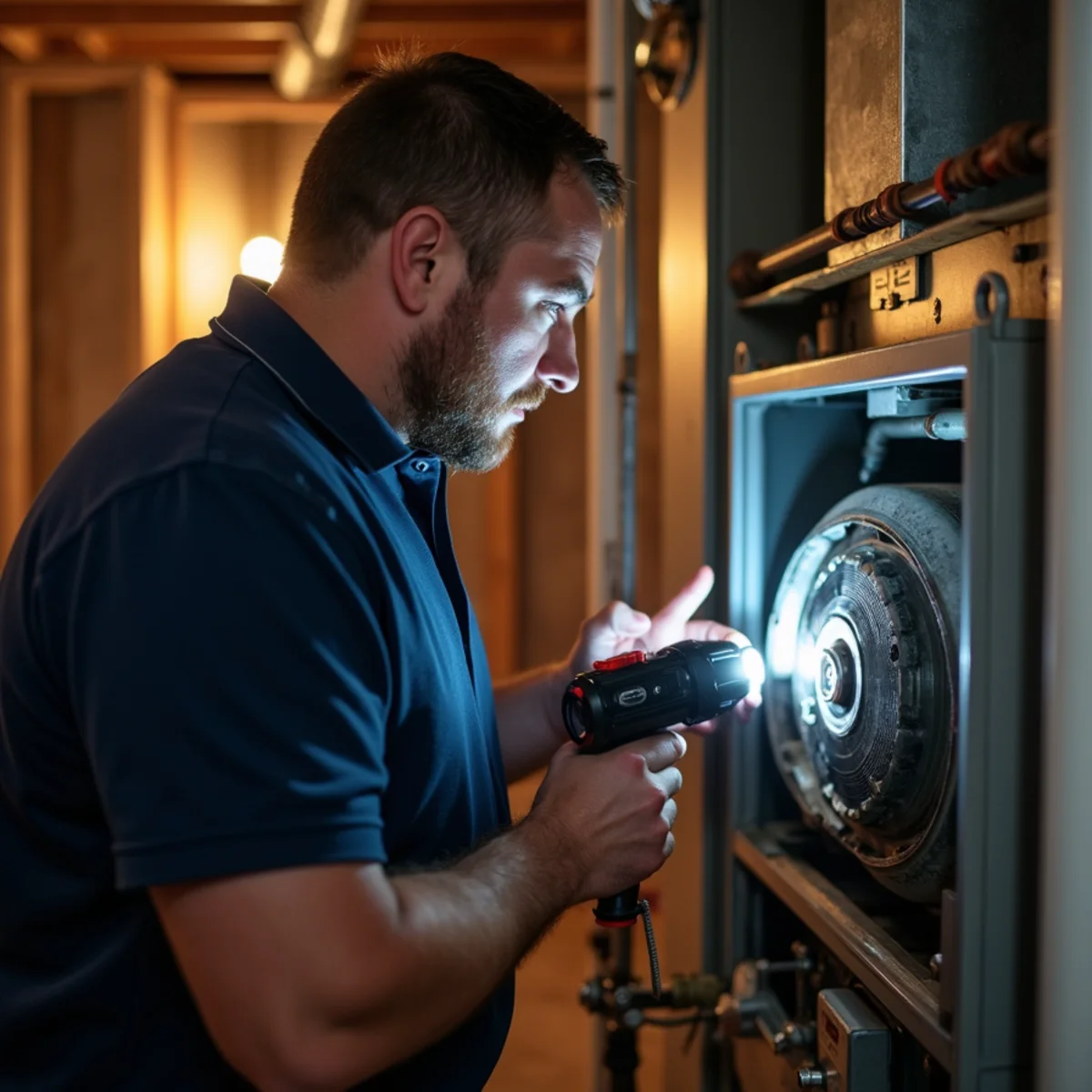
The age on the data plate is only the starting point. On an older furnace we pull the burners, look at the heat exchanger with a camera where we can reach it, and run a combustion analyzer in the flue. Carbon monoxide that climbs after the blower starts, or oxygen readings that shift when air moves across the exchanger, tell us far more than a visual glance. We also measure temperature rise across the furnace and compare it with the range printed on the label. A furnace running well above that range is usually starved for airflow, which is often a duct or filter problem rather than a reason to replace.
The most common mistake we see is replacing a furnace for the wrong reason. A 10-year-old unit that keeps locking out may just need a new flame sensor, a clean condensate trap or a pressure switch hose that has cracked. The opposite mistake is spending on a new inducer motor for a 24-year-old 80 AFUE furnace whose burners are already rusting through. We give you the repair price and the replacement options on the same visit, explain which parts of the system are still healthy, and let you decide without a clock running.
Want a technician to take a look?
Comfort Air Solutions serves Miamisburg, Dayton and the Miami Valley — 24/7 emergency service.
- 4.8★ · 32 Google reviews
- 25+ years’ experience
- Written options before work
- Factory-Authorized Bryant® Dealer